VGF Articles
On the Wider Application of the IIP-VGF Framework
The Evolution of Intelligence and its Environment
In evolutionary teleonomy an organism behaves as though certain outcomes matter: maintaining temperature, acquiring food, avoiding damage, reproducing, caring for offspring, preserving social relationships, and so on. The explanation does not have to be that those future outcomes somehow cause present behaviour. Rather, previous evolution has produced present structures whose operations are selectively organised around such outcomes.
From the VGF perspective, this becomes especially interesting once we stop treating the organism–environment partition as fixed.
Teleonomy as a dynamically maintained closure
In VGF terms, put simply, an organism is a closure whose continuing stability depends upon particular relations with what lies outside it. A bacterium, for example, has a membrane, metabolism, sensory mechanisms and regulatory processes. These together generate something resembling a primitive distinction:
conditions compatible with continuation ↔ conditions incompatible with continuation.
The bacterium does not need an explicit representation of a future state. Its organisation itself embodies this distinction. Movement toward nutrients and away from toxins is therefore teleonomic: it is organised in relation to the continued viability of the organism.
In VGF terminology, the apparent "goal" can therefore be understood as an attractor within the organism–environment coupling.
The attractor is not necessarily a particular physical state. It is more abstractly a region of viable configurations toward which regulatory processes repeatedly return the system.
Homeostasis is the obvious example:
Perturbation -> Regulatory Response -> Return Toward Viable Region
This already resembles the general VGF principle of iterative stabilisation.
But evolution changes the partition itself. This is where the VGF goes further.
Ordinary discussions of teleonomy can inadvertently give the impression of a fixed organism sitting inside a fixed environment and evolving increasingly effective ways of dealing with it. But evolution does not merely modify what happens inside the organism–environment partition. It modifies the partition itself.
Consider the evolutionary progression:
cell membrane
→ multicellular organism
→ nervous system
→ sensory organs
→ locomotion
→ social organisation
→ symbolic communication
→ tools and constructed environments.
At every stage, the effective distinction between "organism" and "environment" is transformed.
A membrane creates one kind of inside/outside relation. A nervous system creates another because events spatially distant from the body can become functionally incorporated into its regulatory activity. Vision, for example, makes something metres or kilometres away relevant to the organism's present internal dynamics.
Behaviour enlarges this further. An animal does not merely adapt internally to an environment; it moves through the environment, selects environments, modifies them and creates niches.
And once we reach social and symbolic intelligence, parts of what performs the organism's teleonomic regulation can lie quite literally outside the biological organism: nests, paths, tools, written language, institutions, cultural memory and eventually technological systems.
So from the VGF point of view, teleonomic evolution and partition evolution are coupled.
Teleonomy therefore evolves recursively
There is consequently something deeper going on than:
'organism evolves better ways of attaining goal G.'
Instead we often have:
organisation -> new capacities -> new organism-environment relation -> new possible teleonomic behaviours -> selection -> new organisation
The organism therefore does not simply become better at solving problems posed by a pre-existing environment. Evolution changes what counts as a problem, what counts as the environment, and what actions are available as solutions.
This makes teleonomy intrinsically recursive.
The evolution of vision creates organisms for whom distant optical structure becomes behaviourally significant. The evolution of flight creates a new ecological possibility-space. The evolution of social intelligence makes other organisms partially constitutive of an individual's survival strategy. Symbolic intelligence produces an even more dramatic change because environments can now include remembered, anticipated and imaginary situations.
Teleonomy therefore generates new teleonomic possibility.
Teleonomy as evolution of constraint rather than pursuit of an endpoint
Instead of saying that evolution "aims at" increasingly intelligent organisms, we could say that evolution repeatedly produces closures which constrain generative possibility into forms capable of maintaining themselves.
Those closures then become the starting conditions for further evolution.
Thus:
variation -> selection -> stabilised constraint -> new possibility space
Teleonomy appears at the level of the stabilised constraint.
A wing constrains matter into a configuration that permits flight. A metabolic network constrains chemical reactions into a self-maintaining cycle. A nervous system constrains enormous behavioural possibility into actions correlated with organismic viability.
None of these requires the future to exert causal influence on the present. The apparent futurity resides in the fact that present organisation contains constraints shaped by the survival consequences of previous iterations.
That is arguably the central evolutionary meaning of teleonomy.
The intelligence of the partition
This also gives us a way to sharpen something we have been developing about intelligence.
In the VGF scientific register, intelligence need not initially mean consciousness or cognition. It can mean something more like:
the capacity of a closure to vary its relations with its environment in ways that preserve or extend its viable organisation.
Under that definition, intelligence lies particularly strongly in the β-domain of organism–environment coupling.
But the boundary through which that coupling occurs is itself an evolutionary product. So we obtain a three-way co-evolution:
organism <-> partition <-> environment
rather than merely:
organism <-> environment.
This matters because a great deal of biological evolution consists precisely in changing what the partition permits.
Membranes become selectively permeable. Sensory systems permit information to cross without matter crossing. Mouths and digestive systems internalise parts of the environment. Reproduction exports organised material across the boundary. Nervous systems allow environmental structures to generate persistent internal traces. Behaviour allows organisms to externalise changes into their surroundings.
The biological partition is therefore not a wall. It is a selectively organised interface.
And one could say that teleonomy progressively becomes embodied in the organisation of that interface.
Teleonomy can therefore migrate across the partition
This becomes even clearer with niche construction.
A beaver's dam changes the environment so that subsequent survival no longer depends solely upon what is happening inside the beaver. Some of the organisation contributing to its viability has been stabilised outside its body.
Human evolution radicalises this.
Fire, clothing, shelter, agriculture, language, institutions and technology increasingly relocate parts of the organism's adaptive structure into the environment.
Teleonomic organisation consequently becomes distributed across organism and environment.
The VGF interpretation would therefore resist saying:
'intelligence is inside the organism and acts upon an external environment.'
It would instead say that evolutionary intelligence increasingly takes the form of a coupled closure whose effective boundary may encompass organism plus portions of its niche. And because closures can be nested, there need not be one uniquely correct boundary.
A human cell has one relevant partition; the organism another; the family another; a society another; an ecological system another.
Teleonomy can occur at several such scales simultaneously without implying that every higher-level structure is literally an organism.
There is therefore an important VGF transformation of the concept
Standard evolutionary teleonomy can be approximately expressed as:
'Present biological organisation behaves in goal-directed ways because previous selection has stabilised structures whose operation tends to produce viability-enhancing outcomes.'
The VGF version deepens to:
'Teleonomy is the recurrent tendency of evolved closures to regulate their coupling with their environments toward regions of continued viability; through evolution, both the closure and the partition defining its relevant environment are themselves recursively transformed.'
This means that teleonomic evolution is not simply movement through a possibility space. It also progressively modifies the possibility space itself:
closure -> teleonomic coupling -> partition modification -> new possibility space -> new closure
This is entirely compatible with non-teleological evolution. There is no predetermined destination in the sequence. Yet at every sufficiently stabilised stage there can be extremely strong local directedness.
So one might make a useful distinction:
VGF teleonomy lets us describe the progressive emergence of intelligence not as evolution moving towards intelligence, but as the iterative evolution of increasingly sophisticated ways in which closures regulate—and eventually partly reconstruct—the relation between "inside" the intelligence and "outside" the intelligence.
From biological teleonomy to general recursive evolution
In species evolution, the principle is comparatively easy to see because biological systems preserve and transmit organisation. What survives at one stage becomes a constraint upon subsequent variation.
So:
From the VGF perspective, this becomes especially interesting once we stop treating the organism–environment partition as fixed.
Teleonomy as a dynamically maintained closure
In VGF terms, put simply, an organism is a closure whose continuing stability depends upon particular relations with what lies outside it. A bacterium, for example, has a membrane, metabolism, sensory mechanisms and regulatory processes. These together generate something resembling a primitive distinction:
conditions compatible with continuation ↔ conditions incompatible with continuation.
The bacterium does not need an explicit representation of a future state. Its organisation itself embodies this distinction. Movement toward nutrients and away from toxins is therefore teleonomic: it is organised in relation to the continued viability of the organism.
In VGF terminology, the apparent "goal" can therefore be understood as an attractor within the organism–environment coupling.
The attractor is not necessarily a particular physical state. It is more abstractly a region of viable configurations toward which regulatory processes repeatedly return the system.
Homeostasis is the obvious example:
Perturbation -> Regulatory Response -> Return Toward Viable Region
This already resembles the general VGF principle of iterative stabilisation.
But evolution changes the partition itself. This is where the VGF goes further.
Ordinary discussions of teleonomy can inadvertently give the impression of a fixed organism sitting inside a fixed environment and evolving increasingly effective ways of dealing with it. But evolution does not merely modify what happens inside the organism–environment partition. It modifies the partition itself.
Consider the evolutionary progression:
cell membrane
→ multicellular organism
→ nervous system
→ sensory organs
→ locomotion
→ social organisation
→ symbolic communication
→ tools and constructed environments.
At every stage, the effective distinction between "organism" and "environment" is transformed.
A membrane creates one kind of inside/outside relation. A nervous system creates another because events spatially distant from the body can become functionally incorporated into its regulatory activity. Vision, for example, makes something metres or kilometres away relevant to the organism's present internal dynamics.
Behaviour enlarges this further. An animal does not merely adapt internally to an environment; it moves through the environment, selects environments, modifies them and creates niches.
And once we reach social and symbolic intelligence, parts of what performs the organism's teleonomic regulation can lie quite literally outside the biological organism: nests, paths, tools, written language, institutions, cultural memory and eventually technological systems.
So from the VGF point of view, teleonomic evolution and partition evolution are coupled.
Teleonomy therefore evolves recursively
There is consequently something deeper going on than:
'organism evolves better ways of attaining goal G.'
Instead we often have:
organisation -> new capacities -> new organism-environment relation -> new possible teleonomic behaviours -> selection -> new organisation
The organism therefore does not simply become better at solving problems posed by a pre-existing environment. Evolution changes what counts as a problem, what counts as the environment, and what actions are available as solutions.
This makes teleonomy intrinsically recursive.
The evolution of vision creates organisms for whom distant optical structure becomes behaviourally significant. The evolution of flight creates a new ecological possibility-space. The evolution of social intelligence makes other organisms partially constitutive of an individual's survival strategy. Symbolic intelligence produces an even more dramatic change because environments can now include remembered, anticipated and imaginary situations.
Teleonomy therefore generates new teleonomic possibility.
Teleonomy as evolution of constraint rather than pursuit of an endpoint
Instead of saying that evolution "aims at" increasingly intelligent organisms, we could say that evolution repeatedly produces closures which constrain generative possibility into forms capable of maintaining themselves.
Those closures then become the starting conditions for further evolution.
Thus:
variation -> selection -> stabilised constraint -> new possibility space
Teleonomy appears at the level of the stabilised constraint.
A wing constrains matter into a configuration that permits flight. A metabolic network constrains chemical reactions into a self-maintaining cycle. A nervous system constrains enormous behavioural possibility into actions correlated with organismic viability.
None of these requires the future to exert causal influence on the present. The apparent futurity resides in the fact that present organisation contains constraints shaped by the survival consequences of previous iterations.
That is arguably the central evolutionary meaning of teleonomy.
The intelligence of the partition
This also gives us a way to sharpen something we have been developing about intelligence.
In the VGF scientific register, intelligence need not initially mean consciousness or cognition. It can mean something more like:
the capacity of a closure to vary its relations with its environment in ways that preserve or extend its viable organisation.
Under that definition, intelligence lies particularly strongly in the β-domain of organism–environment coupling.
But the boundary through which that coupling occurs is itself an evolutionary product. So we obtain a three-way co-evolution:
organism <-> partition <-> environment
rather than merely:
organism <-> environment.
This matters because a great deal of biological evolution consists precisely in changing what the partition permits.
Membranes become selectively permeable. Sensory systems permit information to cross without matter crossing. Mouths and digestive systems internalise parts of the environment. Reproduction exports organised material across the boundary. Nervous systems allow environmental structures to generate persistent internal traces. Behaviour allows organisms to externalise changes into their surroundings.
The biological partition is therefore not a wall. It is a selectively organised interface.
And one could say that teleonomy progressively becomes embodied in the organisation of that interface.
Teleonomy can therefore migrate across the partition
This becomes even clearer with niche construction.
A beaver's dam changes the environment so that subsequent survival no longer depends solely upon what is happening inside the beaver. Some of the organisation contributing to its viability has been stabilised outside its body.
Human evolution radicalises this.
Fire, clothing, shelter, agriculture, language, institutions and technology increasingly relocate parts of the organism's adaptive structure into the environment.
Teleonomic organisation consequently becomes distributed across organism and environment.
The VGF interpretation would therefore resist saying:
'intelligence is inside the organism and acts upon an external environment.'
It would instead say that evolutionary intelligence increasingly takes the form of a coupled closure whose effective boundary may encompass organism plus portions of its niche. And because closures can be nested, there need not be one uniquely correct boundary.
A human cell has one relevant partition; the organism another; the family another; a society another; an ecological system another.
Teleonomy can occur at several such scales simultaneously without implying that every higher-level structure is literally an organism.
There is therefore an important VGF transformation of the concept
Standard evolutionary teleonomy can be approximately expressed as:
'Present biological organisation behaves in goal-directed ways because previous selection has stabilised structures whose operation tends to produce viability-enhancing outcomes.'
The VGF version deepens to:
'Teleonomy is the recurrent tendency of evolved closures to regulate their coupling with their environments toward regions of continued viability; through evolution, both the closure and the partition defining its relevant environment are themselves recursively transformed.'
This means that teleonomic evolution is not simply movement through a possibility space. It also progressively modifies the possibility space itself:
closure -> teleonomic coupling -> partition modification -> new possibility space -> new closure
This is entirely compatible with non-teleological evolution. There is no predetermined destination in the sequence. Yet at every sufficiently stabilised stage there can be extremely strong local directedness.
So one might make a useful distinction:
- Teleology: the future endpoint explains the evolutionary process.
- Teleonomy: previously stabilised organisation constrains present activity toward particular locally viable futures.
- VGF teleonomy: those locally directed processes can themselves alter the closure, its environment, and the very partition through which "goal-directedness" is realised.
VGF teleonomy lets us describe the progressive emergence of intelligence not as evolution moving towards intelligence, but as the iterative evolution of increasingly sophisticated ways in which closures regulate—and eventually partly reconstruct—the relation between "inside" the intelligence and "outside" the intelligence.
From biological teleonomy to general recursive evolution
In species evolution, the principle is comparatively easy to see because biological systems preserve and transmit organisation. What survives at one stage becomes a constraint upon subsequent variation.
So:

where S_n is the stabilised organisation already achieved, and the important point is that the possible S_{n+1} are not independent of S_n.
Evolution therefore does not repeatedly begin again from an unconstrained possibility space. Its history progressively modifies the possibility space.
That is exactly why teleonomy appears. An organism's present organisation embodies the accumulated consequences of earlier selection, so present activity is already biased toward certain viable continuations.
But the VGF proposes that this recursive structure is more general than biology:
stabilisation -> constraint -> re-opened possibility -> further stabilisation
Spacetime permits some subsequent physical organisations and excludes others. Stable physical regularities permit stars. Stellar evolution permits heavier elements. Chemistry permits increasingly complex molecular closures. Planetary environments permit particular forms of self-maintaining chemistry. Biological organisation then creates new evolutionary possibility spaces, eventually including intelligence.
Cosmic evolution would not thereby become teleological
We would not be saying:
cosmos -> life forms -> human intelligence
happens because the universe was teleologically aiming at intelligence.
Rather:

where every achieved stability changes the possibility space available to what comes afterwards.
Biological life is consequently not the goal of cosmic evolution. It is one of the things that became possible inside a possibility space progressively structured by preceding cosmic evolution.
And human intelligence is likewise not the goal of biological evolution. It is one particular stabilisation generated within an already highly structured evolutionary field.
This gives us distinctions we already mentioned:
- teleology: later state determines or explains earlier development;
- teleonomy: existing organisation biases activity toward viable subsequent states;
- general VGF recursion: existing stabilisation structures the possibility space from which subsequent stabilisations can emerge.
Biological teleonomy is therefore in the VGF framework a particularly developed case of the deeper VGF principle that applies to the whole of evolution, not just the evolution of the species.
Species intelligence makes this principle reflexive
Something particularly interesting happens in the case of evolving intelligence.
Before evolving intelligence reaches a sufficiently developed level, previous organisation constrains later possibilities without anything representing those possibilities.
A star does not anticipate stellar evolution. A chemical system does not envisage its next stable state.
Even biological teleonomy need not initially involve representation. A bacterium can behave teleonomically without possessing a conceptual image of its future.
But as intelligence evolves, the recursive principle starts becoming internally modelled.
The organism can increasingly represent possible futures:
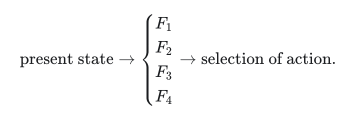
Teleonomy has now become intelligence in a stronger sense.
Instead of evolution alone exploring possibility through differential survival, an organism begins exploring possibility internally before acting.
The arrival of symbolic intelligence which stabilised throughout the human species around 50,000 years ago, enormously amplifies this. Humans can model possibilities which have never occurred at all.
We could therefore describe the evolution of intelligence as a progressive internalisation of evolutionary possibility-space exploration.
The environment is evolving at the same time
It would be misleading to represent the process as:
fixed environment -> organisms adapting to it
The environment itself has a history.
The Earth before life is one environment.
The Earth after microbial life has transformed its chemistry is another.
The oxygenated atmosphere produced through biological activity creates another.
Forests create another.
Animals alter vegetation, soil, nutrient cycles and other species.
Human symbolic and technological activity creates still another.
Thus:

The evolving organism and the evolving environment form a coupled recursive system. And because the partition is itself evolving, even the meaning of O and E changes.
We can now align three levels.
- At the cosmic level: earlier cosmic stability -> structured later cosmic possibility
- At the biological level: earlier evolutionary stability -> structured later organismic possibility
- At the level of intelligence: earlier cognitive stability -> structured perception/action possibility
These are not identical physical processes. But within the VGF they can be understood as different-register instances of the same recursive morphology:
What survives becomes a constraint upon what can happen next.
Which may well be a more fundamental formulation than teleonomy. Teleonomy arises when such constraint becomes organised around the continuing viability of a closure.
There is an environment whose existence and history do not depend upon human cognition in the ordinary scientific sense. Stars, mountains, electromagnetic radiation and chemical reactions did not arise because human beings conceptualised them.
But the environment as encountered, differentiated and understood by an evolved intelligence is inseparable from the structure of that intelligence.
The environment contains immensely more physical differentiation than any organism encounters.
Different organisms disclose different effective environments from it.
A tick inhabits a world structured by temperature, touch and particular chemical signals.
A bat encounters an acoustically articulated environment.
A bee has access to ultraviolet distinctions humans ordinarily do not see.
Humans encounter an environment enormously structured by visual objecthood, spatial relations, causal relations, agency, language and symbolic classification.
So:
Physical environment + evolved intelligence -> effective experience experienced environment.
The partition therefore determines what can become environmentally significant.
Intelligence and environment become complementary evolutionary products
This means that our evolved intelligence cannot simply be placed inside the world as though the two had independent histories.
The intelligence arose from within the same cosmic–planetary evolutionary cascade that produced its environment.
Schematically:
cosmic evolution -> planetary evolution -> biological evolution -> nervous system evolution -> symbolic intelligence.
Consequently, the structure through which we encounter the universe is itself one of the universe's evolutionary outcomes.
It is not that humans merely have subjective filters.
The knowing closure and the known environment share an evolutionary history.
Our intelligence is adapted to distinctions generated within this particular world because it was generated by participation in this particular world.
Reciprocal fit
There is an extraordinary correspondence between:
- the kinds of regularities the world contains,
- the kinds of distinctions organisms are capable of detecting,
- and the structures intelligence uses to model those regularities.
In standard evolutionary terms, part of that fit is unsurprising: organisms whose perceptual and behavioural systems tracked environmentally relevant regularities tended to survive.
But the VGF allows us to see the deeper recursive structure.
- The environment generates organisms.
- Organisms selectively disclose the environment.
- Their activity modifies the environment.
The altered environment changes subsequent evolution.
Thus:

for environment E, organism O, and where P_n is the evolving partition/interface.
This is not simply adaptation.
It is co-evolution of closure, partition and world.
Symbolic intelligence brings the process to an unusual point
With human symbolic intelligence, something novel happens because the environment can become conceptually reconstructed.
Mountains become not merely climbable physical structures but scientifically understood geological formations.
Stars become scientifically understood stellar objects.
Organisms become species.
Matter becomes atoms, fields, particles and quantum states.
The scientific environment we inhabit is therefore partly the result of the accumulated stabilisation of symbolic intelligence.
This absolutely does not mean that science invents the physical world.
It means that:

And those structures subsequently constrain what questions and models become possible.
Science itself becomes recursively evolutionary.
The correlation register
In the VGF framework we develop a correlation register of understanding. This is neither the scientific register, nor another register such as phenomenology of the spiritual register.
In the scientific register, there is cosmic, planetary, biological and cognitive evolution, with causal and historical continuities between them.
In the phenomenological register, there is the world as disclosed through evolved conscious embodiment.
And in the correlation register, we can notice that the architecture through which the world becomes intelligible is itself an outcome of the same evolutionary history that produced the world being understood.
That gives us the striking relation:
The universe produces an intelligence who structure reflects the universe that produced it.
—not because the universe intended to produce a knower, and not because the human knower creates the universe, but because both sides of the eventual subject–environment partition arise within the same recursive stabilisation cascade. The universe is not something that "evolves in order to know itself". Rather, the structure of our evolutionary intelligence and the structure of the universe are two different regimes of the same structure with the same origin.
Conscious phenomenology itself, can also be approached through the same structure, but we must do so in a different register. We must not try to collapse the register of conscious phenomenology into the register of science.
In the VGF framework understanding that structure and the correlation between registers is the business of the correlation register. And the native structure before application in any register, before, for example, putting constraints on it by applying the known scientific facts to it, is the VGF.
Teleonomy may be the local biological image of a more universal VGF principle
In the VGF very achieved stabilisation alters the field of viable subsequent stabilisations.
Biological teleonomy would then be the special case in which that prospective constraint has become organised around the continued viability of a living biological closure:

And intelligence represents a remarkable further development because the possibility space which evolution had previously explored externally begins to be explored internally by the closure itself.
Our environment “as we find it” and our intelligence “as it finds the environment” are not two independently given terms subsequently brought into contact. They are differentiated products of one long recursive evolutionary history, with the organism–environment partition itself emerging and changing within that history.