Towards New Scientific Intelligence
From the Mathematics of Distinction to the Mathematics of Iteration
Modern scientific mathematics is extraordinarily successful in describing the world as a system of distinct entities related by lawful interactions. Whether in physics, biology, or neuroscience, the standard approach begins by identifying stable units—particles, fields, cells, brain regions, variables—and then formalising the relations between them. Even when these systems are dynamic, the formalism typically presupposes that the relevant distinctions are already given. Mathematics, in this register, is fundamentally a mathematics of distinction.
This approach has yielded immense explanatory and technological power. However, it carries an implicit structural commitment: it treats the stability and separability of entities as primary. In terms of the IIP–VGF framework, it operates predominantly within the domain of γ-stabilised closures, analysing how already-formed structures interact and evolve.
Yet many of the most profound phenomena in nature do not merely involve relations between pre-existing distinctions. They concern the emergence, transformation, and dissolution of distinctions themselves. This is especially evident in domains such as:
In such cases, the central question is not only how entities interact, but how entities come to be stabilised as distinct in the first place.
This suggests the need for a complementary mathematical orientation:
a mathematics of iteration, in which the primary object is not the distinction, but the process that generates and stabilises distinctions.
Within this orientation, the primitive is not a set of objects, but a recursive transformation:
This approach has yielded immense explanatory and technological power. However, it carries an implicit structural commitment: it treats the stability and separability of entities as primary. In terms of the IIP–VGF framework, it operates predominantly within the domain of γ-stabilised closures, analysing how already-formed structures interact and evolve.
Yet many of the most profound phenomena in nature do not merely involve relations between pre-existing distinctions. They concern the emergence, transformation, and dissolution of distinctions themselves. This is especially evident in domains such as:
- the transition from quantum coherence to classical spacetime,
- the emergence of life from prebiotic chemistry,
- the formation of multicellular organisms from autonomous cells,
- the development of nervous systems and cognition,
- and the arising of self-consciousness within human intelligence.
In such cases, the central question is not only how entities interact, but how entities come to be stabilised as distinct in the first place.
This suggests the need for a complementary mathematical orientation:
a mathematics of iteration, in which the primary object is not the distinction, but the process that generates and stabilises distinctions.
Within this orientation, the primitive is not a set of objects, but a recursive transformation:

where the system evolves through continuous iteration, and where:

captures the accumulated influence of prior states. Here, structure is not assumed but emerges as a stabilisation of iterative dynamics, conditioned by its own history.
In this framework:
• distinctions correspond to attractor-like closures of iteration,
• persistence corresponds to stability under recursion,
• and change corresponds to transformation of the iterative regime itself.
Mathematics thus shifts its emphasis:
In this framework:
• distinctions correspond to attractor-like closures of iteration,
• persistence corresponds to stability under recursion,
• and change corresponds to transformation of the iterative regime itself.
Mathematics thus shifts its emphasis:
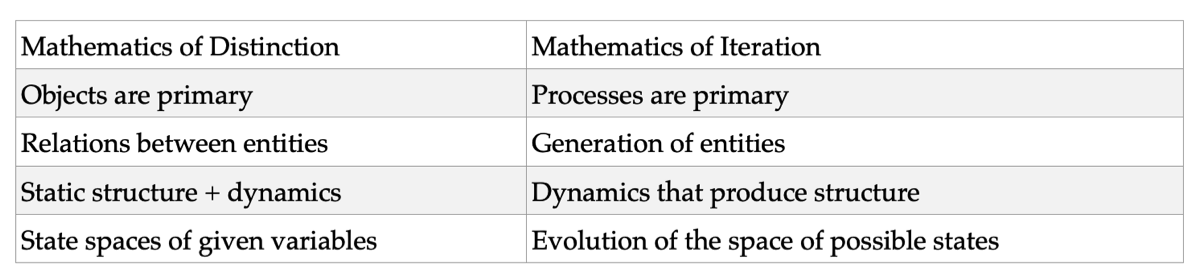
This shift does not invalidate existing science. Rather, it recontextualises it. The mathematics of distinction remains indispensable for analysing stabilised regimes—what has already become coherent and persistent. But it is no longer assumed to exhaust the domain of intelligibility. Instead, it is recognised as a special case of a deeper process in which distinctions themselves arise.
In fields such as neuroscience, this distinction becomes critical. A purely distinction-based approach may treat the brain as a network of identifiable components and functions. A mathematics of iteration, by contrast, allows one to ask how:
Such an approach opens the possibility of discovering new classes of natural regularity, not at the level of object-to-object interaction, but at the level of:
Importantly, this shift does not require abandoning empirical method or causal reasoning. It requires loosening the assumption that all lawful description must begin with already-defined entities. In this sense, it corresponds to a refinement of scientific intelligence itself: a movement from modelling what is already distinct, to modelling how distinction arises.
The mathematics of distinction describes the world as it appears once stabilised.
The mathematics of iteration seeks the laws by which such stabilisation becomes possible.
This does not replace one mathematics with another. It establishes a hierarchy:
In this way, scientific understanding can expand without losing its rigor, moving toward a more comprehensive account of nature as a history-conditioned, self-structuring process rather than merely a collection of interacting parts.
In fields such as neuroscience, this distinction becomes critical. A purely distinction-based approach may treat the brain as a network of identifiable components and functions. A mathematics of iteration, by contrast, allows one to ask how:
- coherent neural activity stabilises into functional patterns,
- these patterns recursively condition future activity,
- and the self/world distinction emerges as a stable regime within ongoing dynamics.
Such an approach opens the possibility of discovering new classes of natural regularity, not at the level of object-to-object interaction, but at the level of:
- stabilisation thresholds,
- regime transitions,
- memory-conditioned dynamics,
- and the coupling of generative and stabilising processes.
Importantly, this shift does not require abandoning empirical method or causal reasoning. It requires loosening the assumption that all lawful description must begin with already-defined entities. In this sense, it corresponds to a refinement of scientific intelligence itself: a movement from modelling what is already distinct, to modelling how distinction arises.
The mathematics of distinction describes the world as it appears once stabilised.
The mathematics of iteration seeks the laws by which such stabilisation becomes possible.
This does not replace one mathematics with another. It establishes a hierarchy:
- at one level, science studies the relations between stabilised forms;
- at a deeper level, it studies the iterative processes that generate those forms.
In this way, scientific understanding can expand without losing its rigor, moving toward a more comprehensive account of nature as a history-conditioned, self-structuring process rather than merely a collection of interacting parts.