The Churning of the Ocean and the VGF
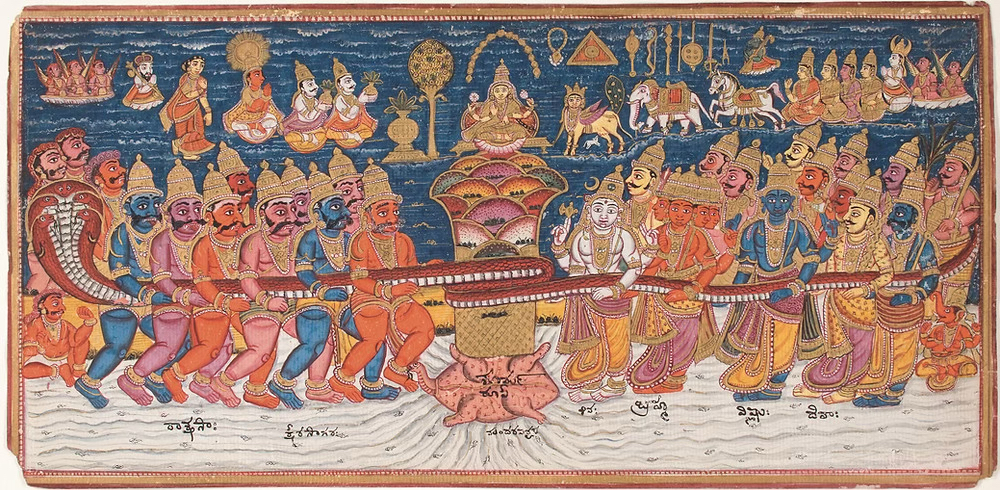
In the Hindu myth of Samudra Manthana, the gods (devas) and anti-gods (asuras) join forces to churn the cosmic ocean (the causal ocean) in search of amrita, the nectar of immortality. Using a mountain as a churning rod (محور) and a great serpent as a rope, they pull back and forth, setting the ocean into motion. From this churning emerges poison, treasures, the goddess Lakshmi, and finally the nectar itself.
Read literally, it is a story of cooperation under tension and an allegory for both the spiritual path and creation. However, everything here, in this world, has structure, including the mind, this myth, and our phenomenology. Read structurally, it becomes something more revealing still: a narrative rendering of how stable form—and something beyond stability—emerges from generative turbulence. This is precisely what the VGF in the IIP-VGF framework - which is scientifically and mathematically based - models. It is a good example of the way which science meets spirit.
The ocean and the beginning of structure
At the heart of the Vast Generative Field (VGF) is a simple but powerful idea: before stable forms appear, there is a condition of open generativity — what we call in the framework the α (alpha) regime. This is the first regime in the principle of infinite iteration (IIP). This is not “nothing,” but a field of potential, not yet resolved into distinct objects.
In the myth, the correlation of this appears as the Ocean of Milk (or causal ocean): undifferentiated, continuous, containing within it the possibility of all forms, but not yet expressing them.
Nothing stable can simply be taken from this ocean. It must be worked, strained, churned.
The necessity of opposition
The most striking feature of the Samudra Manthana is that it requires two opposed groups — devas and asuras, or gods and anti-gods — pulling in opposite directions, in order to find the Amrita - the nectar of immortality.
This is not a moral accident. It is a structural necessity. In infinite recurrence there are three regimes in the generative field, the VGF that arises from it: alpha, beta and gamma. In the VGF, the emergence of structure occurs most intensely at the α–β boundary, where generativity begins to organise but has not yet stabilised. This region is inherently turbulent. And one of its defining features is that it differentiates into opposing tendencies:
* ordering vs destabilising
* persistence vs transformation
* symmetry vs symmetry-breaking
These oppositions are not flaws in the system. They are the mechanism by which generativity becomes structured.
So the devas and asuras can be understood as a mythic expression of something precise: competing β-pathways of closure — different ways in which the field that arises from infinite recurrence attempts to stabilise itself.
Each side represents not a single force, but a family of tendencies, a direction of possible order. Their opposition is the sign that multiple stabilisations are being explored simultaneously.
Churning as generative turbulence
The churning itself—the rhythmic, back-and-forth motion—is the key.
It is not a one-time act. It is iterative, sustained, and effortful. In VGF terms, it corresponds to:
the repeated interaction of competing pathways in a turbulent attractor landscape.
At the α–β boundary, many proto-structures form and dissolve. Some pathways begin to stabilise; others collapse. The system effectively “samples” possibilities through ongoing tension.
Without this process:
* nothing would differentiate
* no structures would be tested
* no stability would emerge
So what the myth calls “churning” is, structurally:
the necessary turbulence through which latent possibility becomes actual form.
Poison and the danger of early formation
One of the most important details of the myth is that the first product of the churning is not nectar, but poison.
This reflects a deep principle.
When generative turbulence first produces structure, the results are often:
* unstable
* destructive
* unsustainable
These are failed or dangerous closure attempts—configurations that amplify instability rather than resolve it.
In the story, the poison must be contained by Shiva. Structurally, this corresponds to the fact that destabilising outputs must be:
* absorbed
* localised
* or neutralised
if the process of emergence is to continue.
Lakshmi and the emergence of order
As the churning continues, more refined forms appear, including the goddess Lakshmi.
Here we begin to see genuine stabilisation.
Lakshmi can be understood as a symbol of:
* harmony
* coherence
* abundance
* the attractiveness of ordered existence
In VGF terms, she corresponds to:
a high-order stable attractor—a successful closure.
This is the level at which structure becomes not only stable, but generative of further order. It is the of γ (gamma), the third regime in VGF structure: persistent, recognisable form.
But the myth does not end here.
Amrita and what lies beyond closure
Finally, the nectar of immortality—amrita—emerges.
Amrita is not just another object among objects, emerging from the ocean.
It represents something more fundamental:
not merely what is most stable, but something beyond, and what is not destroyed by the entire process of becoming.
In the language of the VGF:
* ordinary products of the churning → closures (γ). Mathematically, these are stable closures in infinite iteration.
* But amrita → is not a closure in the same sense.
Rather, amrita is better understood as:
the distillation through turbulence and opposition, of That which participates in the depth of α (alpha - the infinite iteration) without being reducible to form.
Amrita as in the myth, is beyond the cycle of formation and dissolution, or life followed by death. Just as alpha (α) in the IIP-VGF framework, as the scientific correlate, is beyond the closures it forms.
The full movement of the myth
Seen this way, Samudra Manthana structurally describes a complete arc:
* α → undifferentiated generativity (the ocean)
* β → turbulent interaction of competing pathways (devas and asuras, churning)
* γ → stabilised forms (treasures, Lakshmi)
But then it goes one step further:
* beyond γ (without leaving it) → the appearance of amrita.
This final step is crucial. It suggests that the deepest yield of generative turbulence is not only stable structure, but the eventual revelation — through structure — of something that is not exhausted by structure.
A deeper intuition preserved in myth
What this myth captures, with remarkable clarity, is that:
* opposition is necessary
* turbulence is necessary
* instability is necessary
for anything stable to emerge at all.
But it also preserves a second, more subtle, and more important intuition:
that even the most stable forms are not the ultimate outcome of the process.
Beyond the struggle of formation and the success of structure - both in evolution and everything that human beings are engaged in building - there is the possibility of something that does not perish — a depth that is not simply another object, but is instead disclosed through the entire movement of becoming. That depth is consciousness itself.
The churning of the ocean is literally what IIP-VGF generativity looks like when rendered as myth.
Opposed pathways of closure strain against one another in a turbulent field, producing instability, and then order, and then finally revealing — through the process itself (and what is called in modern rather than traditional spiritual terms, coherence recovery) — a distillate of what cannot be destroyed.
Lakshmi is the perfection of form and beauty in form. Amrita is the consciousness of immortality. Just as consciousness in general has a scientific correlate in brain function, so the scientific correlate of Amrita in the framework is α (alpha) - the sign of what exceeds form.
Read literally, it is a story of cooperation under tension and an allegory for both the spiritual path and creation. However, everything here, in this world, has structure, including the mind, this myth, and our phenomenology. Read structurally, it becomes something more revealing still: a narrative rendering of how stable form—and something beyond stability—emerges from generative turbulence. This is precisely what the VGF in the IIP-VGF framework - which is scientifically and mathematically based - models. It is a good example of the way which science meets spirit.
The ocean and the beginning of structure
At the heart of the Vast Generative Field (VGF) is a simple but powerful idea: before stable forms appear, there is a condition of open generativity — what we call in the framework the α (alpha) regime. This is the first regime in the principle of infinite iteration (IIP). This is not “nothing,” but a field of potential, not yet resolved into distinct objects.
In the myth, the correlation of this appears as the Ocean of Milk (or causal ocean): undifferentiated, continuous, containing within it the possibility of all forms, but not yet expressing them.
Nothing stable can simply be taken from this ocean. It must be worked, strained, churned.
The necessity of opposition
The most striking feature of the Samudra Manthana is that it requires two opposed groups — devas and asuras, or gods and anti-gods — pulling in opposite directions, in order to find the Amrita - the nectar of immortality.
This is not a moral accident. It is a structural necessity. In infinite recurrence there are three regimes in the generative field, the VGF that arises from it: alpha, beta and gamma. In the VGF, the emergence of structure occurs most intensely at the α–β boundary, where generativity begins to organise but has not yet stabilised. This region is inherently turbulent. And one of its defining features is that it differentiates into opposing tendencies:
* ordering vs destabilising
* persistence vs transformation
* symmetry vs symmetry-breaking
These oppositions are not flaws in the system. They are the mechanism by which generativity becomes structured.
So the devas and asuras can be understood as a mythic expression of something precise: competing β-pathways of closure — different ways in which the field that arises from infinite recurrence attempts to stabilise itself.
Each side represents not a single force, but a family of tendencies, a direction of possible order. Their opposition is the sign that multiple stabilisations are being explored simultaneously.
Churning as generative turbulence
The churning itself—the rhythmic, back-and-forth motion—is the key.
It is not a one-time act. It is iterative, sustained, and effortful. In VGF terms, it corresponds to:
the repeated interaction of competing pathways in a turbulent attractor landscape.
At the α–β boundary, many proto-structures form and dissolve. Some pathways begin to stabilise; others collapse. The system effectively “samples” possibilities through ongoing tension.
Without this process:
* nothing would differentiate
* no structures would be tested
* no stability would emerge
So what the myth calls “churning” is, structurally:
the necessary turbulence through which latent possibility becomes actual form.
Poison and the danger of early formation
One of the most important details of the myth is that the first product of the churning is not nectar, but poison.
This reflects a deep principle.
When generative turbulence first produces structure, the results are often:
* unstable
* destructive
* unsustainable
These are failed or dangerous closure attempts—configurations that amplify instability rather than resolve it.
In the story, the poison must be contained by Shiva. Structurally, this corresponds to the fact that destabilising outputs must be:
* absorbed
* localised
* or neutralised
if the process of emergence is to continue.
Lakshmi and the emergence of order
As the churning continues, more refined forms appear, including the goddess Lakshmi.
Here we begin to see genuine stabilisation.
Lakshmi can be understood as a symbol of:
* harmony
* coherence
* abundance
* the attractiveness of ordered existence
In VGF terms, she corresponds to:
a high-order stable attractor—a successful closure.
This is the level at which structure becomes not only stable, but generative of further order. It is the of γ (gamma), the third regime in VGF structure: persistent, recognisable form.
But the myth does not end here.
Amrita and what lies beyond closure
Finally, the nectar of immortality—amrita—emerges.
Amrita is not just another object among objects, emerging from the ocean.
It represents something more fundamental:
not merely what is most stable, but something beyond, and what is not destroyed by the entire process of becoming.
In the language of the VGF:
* ordinary products of the churning → closures (γ). Mathematically, these are stable closures in infinite iteration.
* But amrita → is not a closure in the same sense.
Rather, amrita is better understood as:
the distillation through turbulence and opposition, of That which participates in the depth of α (alpha - the infinite iteration) without being reducible to form.
Amrita as in the myth, is beyond the cycle of formation and dissolution, or life followed by death. Just as alpha (α) in the IIP-VGF framework, as the scientific correlate, is beyond the closures it forms.
The full movement of the myth
Seen this way, Samudra Manthana structurally describes a complete arc:
* α → undifferentiated generativity (the ocean)
* β → turbulent interaction of competing pathways (devas and asuras, churning)
* γ → stabilised forms (treasures, Lakshmi)
But then it goes one step further:
* beyond γ (without leaving it) → the appearance of amrita.
This final step is crucial. It suggests that the deepest yield of generative turbulence is not only stable structure, but the eventual revelation — through structure — of something that is not exhausted by structure.
A deeper intuition preserved in myth
What this myth captures, with remarkable clarity, is that:
* opposition is necessary
* turbulence is necessary
* instability is necessary
for anything stable to emerge at all.
But it also preserves a second, more subtle, and more important intuition:
that even the most stable forms are not the ultimate outcome of the process.
Beyond the struggle of formation and the success of structure - both in evolution and everything that human beings are engaged in building - there is the possibility of something that does not perish — a depth that is not simply another object, but is instead disclosed through the entire movement of becoming. That depth is consciousness itself.
The churning of the ocean is literally what IIP-VGF generativity looks like when rendered as myth.
Opposed pathways of closure strain against one another in a turbulent field, producing instability, and then order, and then finally revealing — through the process itself (and what is called in modern rather than traditional spiritual terms, coherence recovery) — a distillate of what cannot be destroyed.
Lakshmi is the perfection of form and beauty in form. Amrita is the consciousness of immortality. Just as consciousness in general has a scientific correlate in brain function, so the scientific correlate of Amrita in the framework is α (alpha) - the sign of what exceeds form.